Irregular Income and Freelancing: How to Pay Yourself a Salary
With irregular income, you pay yourself a fixed salary from a buffer: a separate account that receives client payments. The salary covers your fixed costs and stays below your average monthly income. The buffer holds as many salaries as months you may have to wait for money, usually 2–4. The share of each payment for taxes and VAT moves from the buffer to a tax account the same day; the emergency fund and investments are kept apart.
Rules and amounts for taxes, insurance and registration change every year, and for now Geldchen refers you to official sources and professionals:
- registration, taxes, VAT (Umsatzsteuer): the Finanzamt (tax office) and the ELSTER portal [1]; for a Gewerbe (trade business), also the Gewerbeamt (trade registration office);
- health insurance: the Krankenkasse (statutory health insurer); for artists and writers, the Künstlersozialkasse (artists' social insurance fund) pays part of the contributions [2];
- pension insurance: the Deutsche Rentenversicherung (DRV, statutory pension insurance), where advice is free [3];
- voluntary unemployment insurance: the Bundesagentur für Arbeit (Federal Employment Agency); you can apply only in the first 3 months after you start working for yourself [4];
- a residence permit for self-employment: the Ausländerbehörde (immigration office); over 45, it usually requires adequate retirement provision (§ 21 Abs. 3 AufenthG) [5];
- calculations for your situation: a Steuerberater (tax adviser).
How do you pay yourself a salary with irregular income?
Once a month, on a fixed date, you transfer a fixed amount from the buffer to your Girokonto (current account). Two conditions: it covers your fixed costs, and it is below your average monthly income, otherwise the buffer does not grow. The step-by-step method is in the card smoothing irregular income.
In the first year, without a track record, set the salary at the low end of your forecast. After that, compare it once a year with the average of the last 12 months and raise it if the buffer keeps growing. If your fixed costs are above your average income, the buffer only postpones the problem.
After years as an employee, the first large payment feels like wealth, and that is understandable: as an employee, everything that reached your account was yours. Here, part of the amount is taxes and VAT, and part is your salary for the months ahead.
How big a buffer do you need with irregular income?
The buffer holds as many salaries as months you may have to wait for money. Count the gap between large payments plus the usual payment delay. A large payment once a quarter and a delay of up to a month: a buffer of 4 salaries; payments every month but uneven: 2 are enough.
Geldchen's example: payments arrive every month, €2,733 on average, the salary is €2,500. The worst stretch is three weak months from June to August: €2,700 in payments against €7,500 in salaries, a gap of €4,800. A buffer of two salaries (€5,000) covers it with a margin.
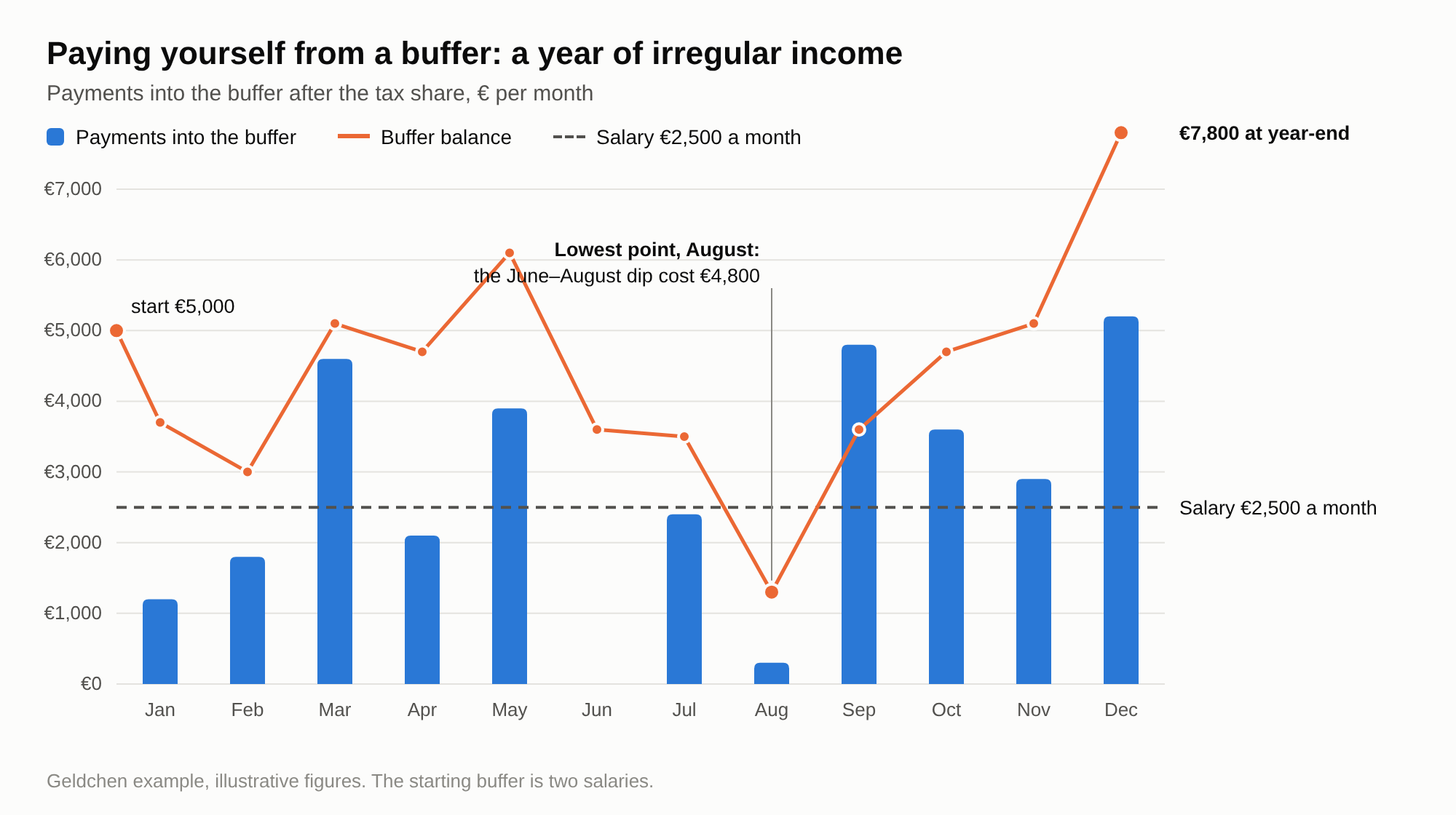
Anything above the buffer either raises the salary or goes into savings and investments. If the salary has started coming out of the emergency fund, the buffer is too small or the salary too high.
What costs do you take on without an employer?
Without an employer, costs that your take-home pay used to hide move into your own budget.
| Item | As an employee | Without an employer | Where it sits in the budget |
|---|---|---|---|
| Income tax | The employer withholds it | Advance payments, then back payments after the tax return | Tax account |
| Health insurance and long-term care insurance (Pflegeversicherung) | The employer pays about half | Usually you pay the whole contribution, including in months with no income | Fixed costs inside the salary; back payments after a recalculation come from the tax account |
| Pension insurance | The employer pays half | A contribution or your own savings, depending on your status | Fixed costs or savings |
| Holidays and sick days | Paid | Days no client pays for | Income is counted on paid days only |
| Planned equipment replacement, software, Steuerberater, liability insurance | The employer; a Steuerberater is usually not needed | You | Sinking fund |
That is why the day rate (Tagessatz) is calculated so that the paid days cover the whole year, together with every item in the table.
How to split your accounts: taxes, buffer, salary, savings
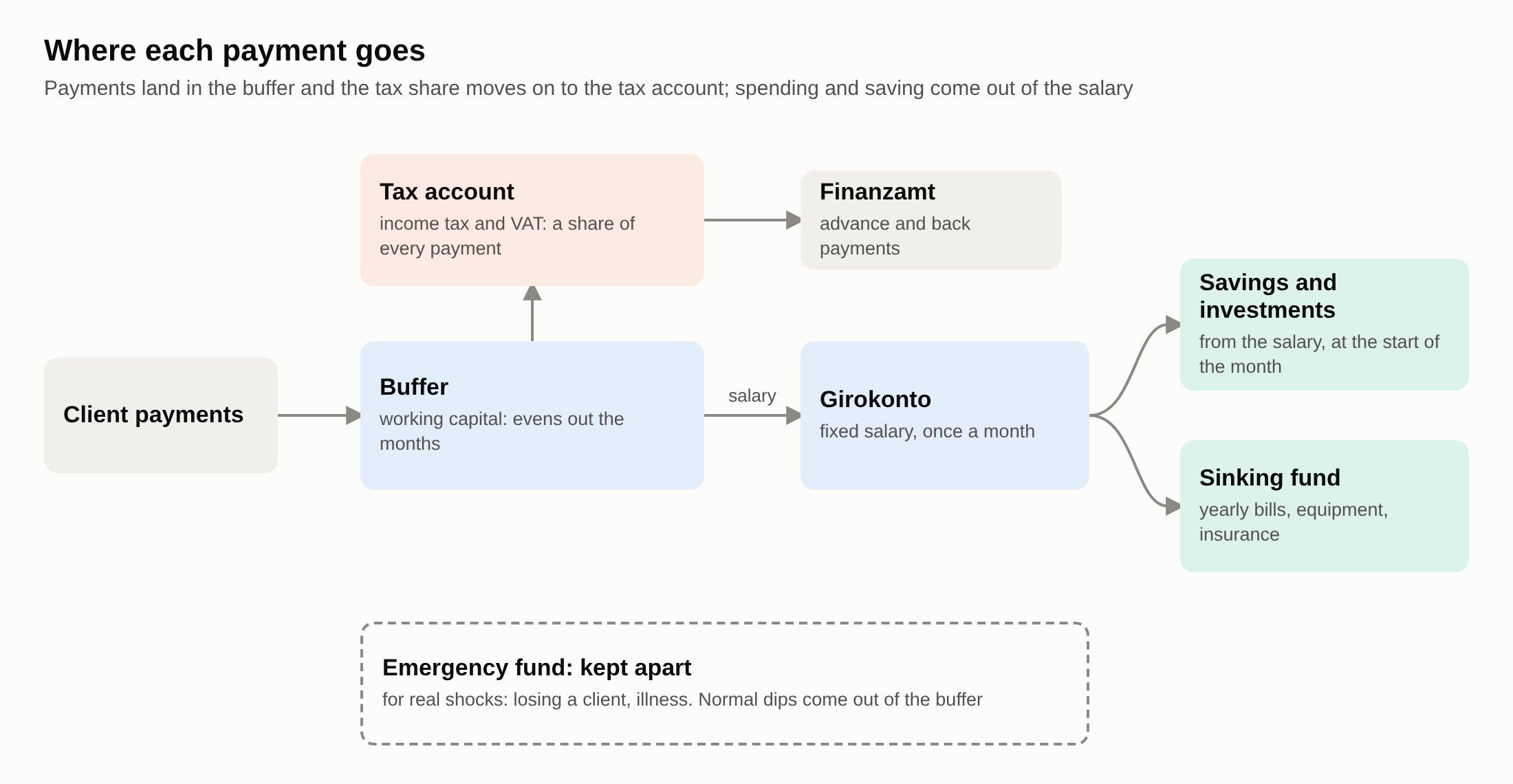
Each client payment goes through three steps:
- The payment arrives in the buffer, and the share for taxes and VAT moves from it to the tax account the same day.
- Once a month, you transfer your salary from the buffer to your Girokonto.
- On payday, transfers go from the Girokonto to savings, investments and a sinking fund before any other spending, following the pay-yourself-first principle.
This is the same three-account structure, with a tax account and a buffer placed in front of the Girokonto.
Separate accounts cut both ways. In a field experiment in India, low-income households saved more when their money was split into two envelopes instead of one (2011) [6]. The flip side: users of an Icelandic personal finance app often hold money in one account while paying overdraft interest on another, because in their minds each account has its own role (2024) [7].
The buffer keeps the Girokonto out of the Dispo (overdraft), which costs 11.3% a year on average (May 2026) [8]. If the account does go negative while the buffer holds money, the gap is closed from the buffer right away; otherwise, it is the same mistake as in the study.
The starting point for the tax share is the Vorauszahlungsbescheid (advance tax payment notice from the Finanzamt). Advance payments are based on your last tax assessment, and in the first year on the profit you estimated yourself in the registration questionnaire [9]. So in a year when your income grows, the final tax is higher than the advances, and if your income falls, you can apply to have the advances lowered.
The tax account isn't emptied after the first payment. One to two years later, depending on when you file the return, the tax assessment for your first year arrives. Based on it, the Finanzamt can demand a back payment and raise the advances at the same time, and the Krankenkasse can recalculate your provisional contributions [10]. VAT from clients isn't income: it is the Finanzamt's money passing through your account.
When do you need a professional?
- The tax share in the first year, VAT, the tax return: a Steuerberater. A Lohnsteuerhilfeverein (wage-tax help association) may not help you if you have taxable income from freelancing or a business [11].
- Your insurance status and whether pension insurance is mandatory for you: the Krankenkasse and the DRV.
FAQ
This is not legal or financial advice.
How do you choose the salary amount with irregular income?
It covers your fixed costs, including health insurance contributions, and stays below your average monthly income, so the buffer grows on average. Once a year, compare it with the average of the last 12 months.
How many months does the buffer need to cover?
As many as the months you may have to wait for money: the gap between large payments plus the payment delay. Usually 2–4 salaries; in Geldchen's example with monthly payments, two are enough.
How is a buffer different from an emergency fund?
The buffer covers normal dips between months and pays your salary. The emergency fund is kept separately for large unexpected events: losing your main client, illness. If the salary starts coming out of the emergency fund, the buffer is too small or the salary is too high.
How much do freelancers need to set aside for taxes?
There is no single percentage for everyone: the share depends on your profit, the progressive tax scale and VAT, and the percentages quoted on forums are sometimes based on turnover, sometimes on profit. The Vorauszahlungsbescheid from the Finanzamt gives a starting point, but it rests on your last tax assessment or, in the first year, on your own profit estimate; a Steuerberater estimates the share for the first year and for a year when your income grows.
Sources
- ELSTER — the Finanzamt's tax portal: registering your business, tax returns, 2026. https://www.elster.de
- Künstlersozialkasse — social insurance for artists and writers: the KSK covers part of the contributions to health, pension and long-term care insurance, 2026. https://www.kuenstlersozialkasse.de
- Deutsche Rentenversicherung — Selbstständig: Wie die Rentenversicherung Sie schützt (brochure; free advice at the Auskunfts- und Beratungsstellen), 2026. https://www.deutsche-rentenversicherung.de/SharedDocs/Downloads/DE/Broschueren/national/selbstaendig_wie_rv_schuetzt_aktuell.pdf?__blob=publicationFile
- Bundesagentur für Arbeit — Fachliche Weisungen § 28a SGB III (Versicherungspflichtverhältnis auf Antrag for Selbstständige; deadline for applying after you start), 2026. https://www.arbeitsagentur.de/datei/fw-sgb-iii-28a_ba037220.pdf
- Aufenthaltsgesetz § 21 Abs. 3 (self-employed people over 45 are, as a rule, granted a residence permit if they have adequate retirement provision) — gesetze-im-internet.de, 2026. https://www.gesetze-im-internet.de/aufenthg_2004/__21.html
- Soman, D., Cheema, A. — Earmarking and Partitioning: Increasing Saving by Low-Income Households. Journal of Marketing Research, 48 (Special Issue), S14–S22, 2011. https://doi.org/10.1509/jmkr.48.SPL.S14
- Gathergood, J., Olafsson, A. — The Coholding Puzzle: New Evidence from Transaction-Level Data. The Review of Financial Studies, 39 (6), 1877–1908; online 2024, in print June 2026. https://doi.org/10.1093/rfs/hhae016
- smava — Dispozins-Index: average overdraft rate 11.3% (May 2026), 2026. https://www.smava.de/presse/dispozinsen/
- Einkommensteuergesetz § 37 (Einkommensteuer-Vorauszahlung: advance payments set by the Finanzamt's notice based on the last tax assessment or, in the first year, the expected profit; lowering them on application) — gesetze-im-internet.de, 2026. https://www.gesetze-im-internet.de/estg/__37.html
- Sozialgesetzbuch V § 240 Abs. 4a (GKV contributions for Selbstständige: provisionally based on the last tax assessment, in the first year on expected income; finally based on the assessment for that year) — gesetze-im-internet.de, 2026. https://www.gesetze-im-internet.de/sgb_5/__240.html
- Steuerberatungsgesetz § 4 Nr. 11 (Lohnsteuerhilfevereine may not help members with taxable income from Gewerbebetrieb or selbständige Arbeit) — gesetze-im-internet.de, 2026. https://www.gesetze-im-internet.de/stberg/__4.html