GKV vs PKV: The Mechanics of the Two Systems
A GKV contribution depends on income and on the rate of the Krankenkasse (statutory fund). A PKV premium is calculated from a tariff for a pricing group of people of the same age and sex; part of the premium builds a reserve for spending in old age. Both prices change, but under different rules: the GKV contribution every year through the rate, the PKV premium through a recalculation whenever the pricing group's claims drift from the calculation. Below: how each price is built, what it contains, what grows and who sets the prices. The rules, the cost by salary and the order of steps are in the main article on health insurance.
How many people are in each system
| Indicator | Value | Year |
|---|---|---|
| Insured in GKV | about 74 million (58.5 million members plus about 16 million co-insured family members) | 2025 [3] |
| Fully insured in PKV | 8.79 million | 2025 [1][9] |
| Of them with Beihilfe (civil-service health subsidy: civil servants and their families, the state reimburses part of the bills) | 4.66 million, 53% | 2024 [1] |
| Insured in PKV without Beihilfe | 4.08 million; down 418,000 since 2015 | 2024 [1] |
| Moved from GKV to PKV | 186,500 | 2024 [1] |
| Returned from PKV to GKV | 105,700, 1.2% of the insured | 2024 [1] |
| Insured in PKV social tariffs | 177,200: 2.0% of all, about 4% of those without Beihilfe | 2024 [1] |
An employee earning under €77,400 a year (2026) is insured in GKV by law and chooses only the Krankenkasse. Since 2015 the number of PKV insured without Beihilfe has fallen by 418,000, while the number of Beihilfe recipients has grown by 370,000 [1]. PKV averages, including the premium per person, mix the two groups.
How a GKV contribution is calculated
- General rate: 14.6% of gross salary, split equally with the employer [4].
- Zusatzbeitrag (supplementary contribution): each Krankenkasse sets its own; the calculated average for 2026 is 2.9%, the actual weighted average in September 2026 is 3.13% [4]. Split equally.
- Contribution ceiling: €69,750 a year (2026); income above it is not charged [4].
- Pay-as-you-go funding (Umlageverfahren): this year's contributions pay for this year's treatment. There is no individual reserve for old age. The rate is reviewed every autumn against the spending forecast.
- How it has moved: the calculated average Zusatzbeitrag rose from 1.7% to 2.9% between 2024 and 2026 [4].
The insured person's own treatment costs have no effect on the contribution.
How a PKV premium is calculated
Pricing group. The premium is calculated when the contract is signed, for a specific tariff. Within a tariff, insured people of the same sex and entry age form a pricing group (industry texts call it a cohort). The premium depends on entry age, state of health and the chosen tariff, not on income.
Ageing reserve. Part of the premium goes into an ageing reserve (Alterungsrückstellung). It pays for the rise in the insured person's own costs with age along the "cost of treatment by age" curve built into the tariff. This is why the insured person's own ageing does not raise the premium.
Recalculation. The reserve does not cover the rise in the cost of treatment at every age. Every year the insurer compares the pricing group's actual claims with the calculated ones. If the deviation exceeds 10% (or 5%, if the tariff says so), the premium is recalculated for the whole group, regardless of what any individual insured person has cost (§ 155 VAG) [5]. Future medical inflation may not be priced in; it enters the premium after it has been observed. This is why the premium moves in steps: several years of cost growth land in a single recalculation.
At the end of 2024 the industry's ageing reserves stood at €342 billion, on average about €32,600 per fully insured person; the average premium for full cover was €3,688 a year. These are averages across all insured people, including those with Beihilfe, not figures for an individual contract [1].
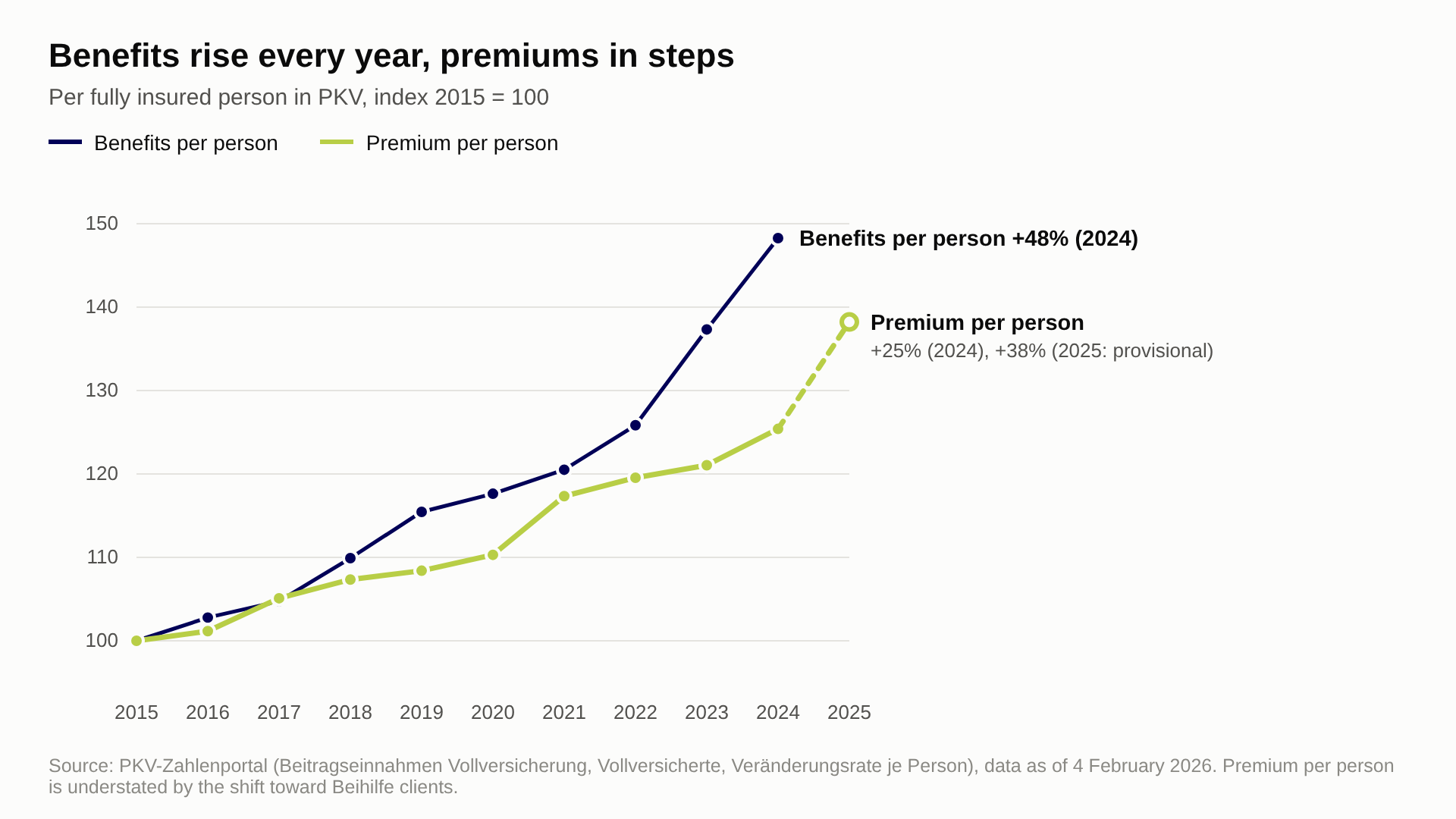
| Year | Benefits per insured person, growth | Full-cover premium per insured person | Premium growth |
|---|---|---|---|
| 2016 | +2.8% | €2,975 | +1.1% |
| 2017 | +1.9% | €3,091 | +3.9% |
| 2021 | +2.5% | €3,451 | +6.4% |
| 2023 | +9.1% | €3,560 | +1.2% |
| 2024 | +8.0% | €3,688 | +3.6% |
| 2025 (prelim.) | about +6.5% | €4,065 | +10.2% |
Source: [1], calculated from the PKV-Zahlenportal series, the PKV association's statistics portal. Benefits per insured person are the average across all insured people; the premium per insured person is full-cover premium income divided by the number of fully insured people.
Over 2015–2024, benefits per person rose by 48% and the premium per person by 25%. The PKV association reported increases averaging 18% for roughly two thirds of the insured from January 2025 [7] and 13% for roughly 60% from January 2026 [6].
These series show the gap between the growth of spending and of average premiums; they cannot explain why a specific tariff was recalculated. Part of the gap comes from the growing share of Beihilfe customers, whose tariffs cover only 20–50% of costs.
Two tariff designs [5]:
| With ageing reserve (nach Art der Lebensversicherung, life-insurance style) | Without reserve (nach Art der Schadenversicherung, non-life style) | |
|---|---|---|
| Where it is allowed | Mandatory for full (substitutive) insurance, § 146 VAG | Only supplementary and temporary insurance, for example for the first months in Germany |
| How the premium depends on age | Your own ageing is priced in up front, through the reserve | The premium rises when you move into the next age band on the tariff's scale |
| Reserve for old age | Yes; a variant with a Beitragsentlastung module: more expensive now, cheaper from 65 | No |
| What drives later changes | The pricing group's costs, longevity, the assumed interest rate | The pricing group's costs and the age scale |
The statement "the premium does not rise with age" refers only to the insured person's own ageing. Rising treatment costs, longevity and changes in the assumed interest rate feed into both designs.
What is published about a specific tariff. Insurers do not publish the recalculation history of their tariffs; the association's portal gives industry totals. The starting price and the industry averages do not allow anyone to determine a specific tariff's future increases. Evaluating one takes its conditions (scope of cover, deductible, recalculation rules) and, where available, its recalculation history from paid sources: the long-term tariff studies by Finanztest and the Map-Report ratings.
A tariff closed to new customers ages as a group: healthy insured people can move to other tariffs of the same insurer (§ 204 VVG), the rest stay, and the group's costs per person grow faster than the industry average. Hence the editorial rule of thumb: a young, small or cheapest-on-the-aggregator tariff is an open group with a short history, and we expect its price to approach the market-average cost curve over a few recalculations. No tariff-level data that would confirm or refute this rule is publicly available.
Interest rates: how they enter the premium
Ageing reserves are invested, mostly in long-term bonds. When calculating the premium, the insurer sets an assumed interest rate (Rechnungszins), the expected return on these investments: the lower it is, the more has to be set aside today for the same future costs. GKV has no such component: it builds no reserves.
| Year | Assumed interest rate | Current portfolio yield | Difference | Excess interest credited to the insured (§ 150 VAG) |
|---|---|---|---|---|
| 2015 | 3.41% | 3.66% | +0.25 | €541 million |
| 2019 | 2.80% | 2.78% | −0.02 | €888 million |
| 2022 | 2.34% | 2.60% | +0.26 | €451 million |
| 2024 | 2.19% | 2.79% | +0.60 | €1,089 million |
Source: [1], industry averages.
- How the rate entered the premium. Over the period shown, the assumed interest rate fell from 3.41% to 2.19%. A change in the assumed rate is not in itself a trigger for recalculation: it is taken into account at the next claims-driven recalculation (§ 155 VAG) [5]. So the falling rate entered premiums in pieces, together with other recalculations.
- Where returns above the assumed rate go (§ 150 VAG) [5]: 90% of such returns are credited to the insured every year, from 2025 entirely to individual reserves. From age 65 these credits go to softening increases; what remains from age 80 lowers the premium. They are not paid out in cash and do not lower a young insured person's premium.
- Position in 2024. The portfolio yield exceeded the assumed rate by 0.6 percentage points; the excess interest credited to the insured had doubled compared with 2015.
These industry averages do not help in timing a contract: a specific tariff's assumed interest rate is reviewed at recalculation, and the size of the recalculation is set by the pricing group's claims.
Spending growth and indirect usage indicators
The association's portal publishes benefits in money, not case counts. Two series can serve as indirect volume indicators, because they pay a fixed sum per day: daily sickness benefit (Krankentagegeld) and daily hospital benefit (Krankenhaustagegeld). They do not describe all illnesses and contacts with care.
| Per insured person, 2015 → 2024 | Change | How the indicator can be read |
|---|---|---|
| Sickness benefit (Krankentagegeld) | +4% | days of long-term incapacity among those who insured this risk |
| Daily hospital benefit | −14% | days in hospital among those who insured this risk |
| General hospital services (DRG) | +68% | cost of one stay: price and volume of services per stay |
| Physician, outpatient | +46% | number of services and multipliers on the bills |
| Medicines | +75% | prices and new drugs |
| Chief physician (Chefarzt) | −11% | spending on this hospital option |
Source: [1]. The two volume indicators did not grow in ten years; benefits for hospital services, physicians and medicines grew by 46–75%. Hospital prices are set outside PKV (DRG rates, nursing budget at actual cost), drug prices by the market and negotiations. Growth in these benefits enters the tariff calculation and, once the threshold is exceeded, leads to a recalculation under § 155 VAG.
GOÄ bills
Private patients have a separate price system. A physician bills a PKV patient, a civil servant with Beihilfe and anyone paying out of pocket under the physicians' fee schedule (Gebührenordnung für Ärzte, GOÄ), which the federal government adopts by ordinance. GKV uses a different catalogue, the EBM, and the patient does not see a bill. The GOÄ point value has not changed since 1996: about 5.8 cents. The price of a service is set by the multiplier: up to 2.3× no justification is needed, from 2.3× to 3.5× a written justification on the bill is required, above 3.5× a fee agreement (Honorarvereinbarung) signed before treatment [1].
| Share of fees above the standard multiplier | 2019 | 2022 | 2024 |
|---|---|---|---|
| Outpatient physicians (above 2.3×) | 13.1% | 15.8% | 19.9% |
| of which at the maximum 3.5× | 9.7% | 11.5% | 14.2% |
| Dentists (GOZ, above standard) | 43.6% | 48.3% | 53.0% |
Source: [1].
- Who pays the bill. The patient receives the physician's bill and is responsible for paying it. The insurer reimburses under the tariff's conditions; if the tariff caps reimbursement, the difference stays with the patient.
- How bills enter the premium. Reimbursed amounts count towards the pricing group's claims and, once the threshold is exceeded, lead to a recalculation under § 155 VAG.
- GOÄ and EBM define the physician's remuneration differently. Data on waiting times for a specialist appointment are in the section on the bodies that set prices.
GOÄ reform: status
The draft of the new GOÄ (GOÄneu) is a joint proposal by the German Medical Association (Bundesärztekammer, BÄK) and the PKV association, agreed with the Beihilfe payers. Version 6 of 15 July 2026, 1,049 pages, has been handed to the health ministry. It is a draft, not law: it needs to be adopted as a government ordinance with an amendment to § 11 Bundesärzteordnung. The text names no effective date; BÄK calls 1 January 2028 a realistic target [8][10].
What the draft changes
The draft replaces the 1996 price list: a new catalogue of services (about 5,500 items instead of 2,800, including the medicine of the last 30 years) and new prices for it [10][11].
- The usual multiplier range of 1.0–3.5× disappears. Every item has a fixed price in euros, below which billing is not allowed. Special circumstances are paid through surcharges: 1,325 of the draft's 5,580 items are surcharges.
- The 1.5× and 2× multipliers remain in certain chapters under defined conditions (clotting disorders, BMI of 40 or more, certain operations, anaesthesia, radiology), with a mandatory justification on the bill. Individual fee agreements (§ 2) remain, except in chapters E, M, N and O.
- The bill becomes machine-readable. Analogue items are marked "A", and the patient is warned about them in writing before the service.
- Social tariffs (Basis-, Standard-, Notlagentarif): the accompanying bill proposes a rate of 0.85× GOÄ for them, keeping the 2× cap for dentistry (GOZ); the draft does not rewrite the GOZ itself.
Cost forecast. BÄK and the PKV association forecast a rise in PKV spending of up to 13.2%, about €1.9 billion, over the first three years. This is the industry's forecast; the ministry's assessment had not been published as of October 2026 [11]. One service as an example: an initial consultation with examination costs €9.32 / €21.44 / €32.64 today under items 1 and 5 at 1.0× / 2.3× / 3.5×; under the draft, items 1 and 15, it costs €28.47 [10].
What the draft changes and what we dislike in it. The draft closes a 30-year gap in the catalogue and removes the multiplier the physician chose alone. This is a repair of the price level, not of the mechanism: the prices are fixed in euros without indexation, and updating them remains political, by the same route that froze the old schedule. Rigid price control is itself a large problem.
What the comparisons show. Germany spends 12.3% of GDP on health, the most in the EU; the Netherlands 10.0%, Spain 9.2% (2024). Yet treatable mortality in Germany is higher (66 against 49 and 50 per 100,000), and life expectancy is no higher (81.1 years against 81.9 and 84.0) [22].
Our conclusion: prices closer to market prices would be an adequate goal, but the draft does not discuss how to get there. One price for the whole country allows neither for the density of physicians, nor for rent, nor for the age of patients, and the one lever a practice used to adjust the price to its own situation disappears. In our assessment it is the GOÄ that explains most of why a private patient gets to a doctor faster in everyday life: the doctor earns more from them.
What we expect. The transition will require every practice to rebuild its billing and bill checking. The difference in access will show in who still takes private patients. The pressure on price will not disappear; it will move from the multiplier into surcharges, per-minute units, analogue items and fee agreements. The multiplier was crude, but its drift could be measured; these channels the portal does not show. So we expect the creep to continue and to become harder to trace.
Who sets prices and payment rules
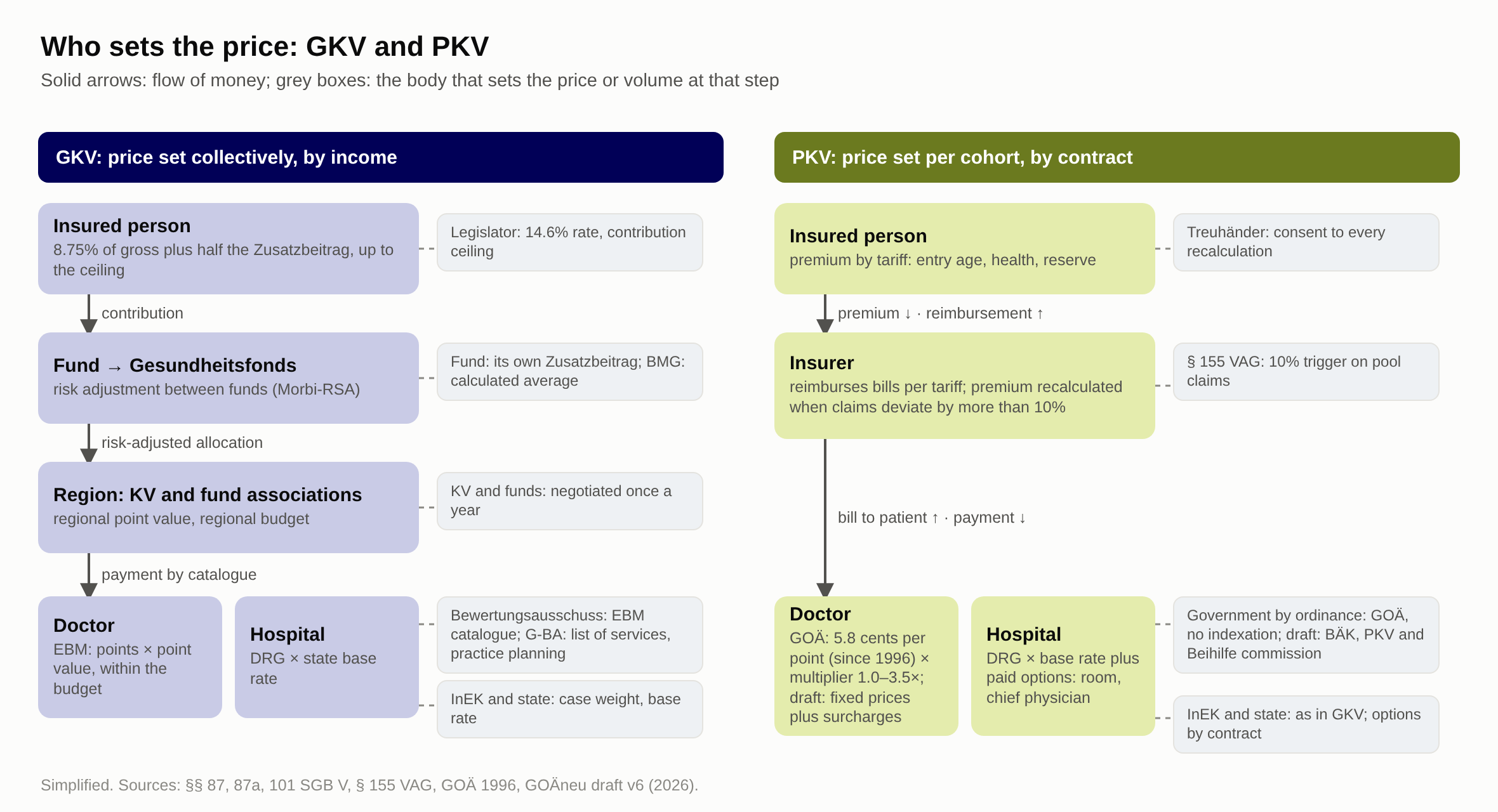
Prices, the volume of paid care and the rules for opening a practice are set by different bodies. The diagram shows who sets the price at each step; the table shows their powers. Abbreviations: G-BA, the federal joint committee of physicians and funds; KV, the regional association of statutory-fund physicians; EBM, the GKV catalogue of services in points; DRG, the weight of a hospital case; InEK, the institute for hospital tariffs.
| What is regulated | Who decides | Instrument |
|---|---|---|
| Where a practice may open | G-BA sets the rules, state committees (Landesausschüsse) apply them | needs-based planning (Bedarfsplanung) separately for each group of physicians: at coverage above 110% a district is closed to new physicians [5] |
| Consultation hours | law | at least 25 hours a week with a full practice licence (Versorgungsauftrag) [5] |
| Price of an outpatient service in GKV | the valuation committee of physicians and funds (Bewertungsausschuss) | the EBM catalogue in points; the point value is reviewed once a year [12] |
| Regional price and volume | KV and the state associations of funds | regional point value, regional budget, distribution among physicians [5][16] |
| Exceptions to the rules | legislator | payment for new patients outside the budget (2019–2022, repealed), surcharges for appointments booked through the 116117 service, removing the budget cap for family doctors (Hausärzte) from October 2025 [20][21] |
| Price of a hospital case | InEK, the federal associations of hospitals, funds and PKV, negotiations in each state | DRG multiplied by the state base rate within a common corridor [15] |
| Price of a private service | government by ordinance; under the reform draft, a commission of BÄK, PKV and Beihilfe | GOÄ: point value unchanged since 1996, no indexation in the draft either [10] |
| PKV premium | the insurer with the consent of an independent trustee (Treuhänder) | recalculation when claims deviate by more than 10% (§ 155 VAG) [5] |
| Indicator | Data |
|---|---|
| Point value and inflation | The EBM point value rose from 10.4361 cents in 2016 to 12.3934 cents in 2025, by 19%; consumer prices rose by 28% [12][13][14]. In real terms that is minus 7.5%. The GOÄ point did not change over these years |
| Regional spread of rates | The 2026 hospital base rates in 14 of 16 states differ by less than 0.4%, at most by 2.6% [15]. The regional mark-up on the point value in Hamburg is 0.326% [16]. For comparison, one practice cost item: rent per square metre differs 3.8-fold between Chemnitz and Munich (city comparison) |
| Number of physicians and working hours | In 2025, 191,875 physicians and psychotherapists worked in the GKV system, 1.2% more than a year earlier; over 70,000 of them part-time. By KBV's calculation, 25,000 departing full-time physicians will be replaced by about 50,000 part-time ones [17]. A practice owner spends about 14 hours a week on work without a patient (2016 survey) [18] |
| Waiting for an appointment | In a 2017–2018 field experiment (calls to 991 practices), GKV insured waited an average of 25 days for a specialist appointment, private patients 12 [19] |
International comparison (OECD, Health at a Glance 2025) [22]:
| Indicator | Germany | Comparison | Year |
|---|---|---|---|
| Physicians per 1,000 residents | 4.7 | OECD 3.9; across German regions roughly 3.7 to 6.4 (read from the chart) | 2023; regions 2019 |
| Beds per 1,000 residents | 7.7 | OECD 4.2 | 2023 |
| Average hospital stay, days | 7.5 | OECD 6.4 | 2023 |
| Waited more than a month for a specialist | 45% | Netherlands 37% | 2023 survey |
On the design. Supply, hours, price, volume, specialty and region are each regulated separately, and each body has its own interest: physicians want income, funds a stable contribution, hospitals occupancy, the states their own hospitals, insurers predictable claims, the state its budget. There are about ten bodies, and they are loosely connected. Fixes arrive as add-ons: pay for new patients outside the budget, then repeal it, add a surcharge for booking, remove the budget cap for one group of physicians. Nowhere is there an automatic link between prices and inflation, and the annual regional negotiations yield a spread of fractions of a percent.
What this means for the insured. The queue, the short appointment and the gap in access between GKV and PKV, in our assessment, follow to a large degree from this design, not from the particulars of an individual practice.
Increases are visible in different ways. A PKV premium increase arrives as a letter with a percentage for the pricing group. A GKV increase arrives through the Zusatzbeitrag (calculated average 1.7% in 2024, 2.9% in 2026, actual 3.13% in September 2026 [4]), the contribution ceiling and the federal subsidy, with no letter. Both systems carry the same growth in the cost of treatment; the difference is who pays it and how visibly.
What the reserve solves and what it does not. The PKV reserve pays for each pricing group's own ageing [5]; pay-as-you-go GKV shifts the ageing of the population onto the next generation of contributors.
In the OECD's decomposition for OECD countries as a whole, demographics explain about a quarter of the projected growth in public health spending; the rest is income, productivity and technology, which press on both systems alike. For Germany the OECD projects real public health spending per person to grow by 1.6% a year against an OECD average of 2.6% [22][23]. Part of PKV's lower averages comes from the composition of the pool, 53% with Beihilfe, not from the mechanics [1].
Editorial conclusion. PKV works as a price signal by pricing group. Political calls to close PKV would remove this signal from the system, not the cause it points to.
What can be changed: tariff, insurer, system
| Change | GKV | PKV |
|---|---|---|
| Change organisation | The Krankenkasse: after 12 months of membership, without a health check, without a gap in cover (§ 175 SGB V) [5] | The insurer: the reserve transfers only for contracts from 2009 onwards and only up to the Basistarif level; the new insurer runs a health check [5] |
| Change tariff | One catalogue for all funds | Within the insurer, by law (§ 204 VVG), keeping the reserve and without a health check for equal or lower benefits; the number of such switches is not published [5] |
| Move to the other system | To PKV: on application, where there is a right to choose | To GKV: only when compulsory insurance begins (employment below the threshold, ALG I benefit) [24]; closed from age 55 (§ 6 Abs. 3a SGB V) [5][25] |
| When the income threshold rises | — | A rising threshold by itself does not return anyone to GKV: within three months you can apply for an exemption and stay in PKV, irrevocably (§ 8 SGB V) [5] |
The route back to GKV through ALG I, the notice periods for a PKV contract and the refund of premiums are described in the main article. In 2024, 105,700 people returned from PKV to GKV, 1.2% of the insured [1]; the PKV association links a large part of the returns to the rising income threshold [2].
Insured in social tariffs (Basis-, Standard-, Notlagentarif) (end of 2024) [1]:
- 177,200 people: 53,100 in the Standardtarif, 35,000 in the Basistarif, 89,100 in the Notlagentarif. That is 2.0% of all fully insured and about 4% of those without Beihilfe; the share has not changed since 2015.
- The number insured in the Notlagentarif has fallen by 22% since 2015; the number in the Basistarif with a half premium has risen by 33%.
- No ageing reserve is built in the Notlagentarif, so time spent in it raises future premiums.
- These data do not show the number of switches between ordinary tariffs; the portal does not publish such a series.
What can be checked before choosing
| Factor | GKV | PKV |
|---|---|---|
| What sets the price | Income and the fund's Zusatzbeitrag; treatment costs have no effect | The tariff, entry age and health at signing; after that, the pricing group's costs |
| How it changes | Every year, through the fund's rate | By recalculation, when the group's claims deviate from the calculation by more than 10% |
| Individual reserve for old age | None | Built up |
| What can be checked in advance | The fund's Zusatzbeitrag by year (GKV-Spitzenverband list) | The tariff's conditions; recalculation history only in paid sources |
| Family | Free if the family member's income is under €565/month (2026); from 2028 a surcharge for a spouse | A separate premium for each person |
| Changing organisation | Krankenkasse: after 12 months | Insurer: with limited transfer of the reserve and a health check |
| Changing system | To PKV, where there is a right to choose | To GKV when compulsory insurance begins, before 55 |
| Payment | A share of income; follows it | The premium is independent of income and is recalculated |
FAQ
This is not legal or financial advice.
How do GKV funds differ from one another?
The basic scope of benefits is the same at every fund: the law sets it (§ 11, § 12 SGB V), and the Federal Joint Committee (G-BA, Gemeinsamer Bundesausschuss) defines the specific indications and methods in its directives (§ 92 SGB V) [5]. Three things differ: the Zusatzbeitrag (in 2026 from 2.18% to 4.39% [4][26]), extra benefits under the fund's statutes (§ 11 Abs. 6 SGB V: prevention, osteopathy, bonus programmes) and service. Treatment under the main catalogue does not depend on the choice of fund.
Does the fund or the insurer decide how I am treated?
The physician prescribes. In GKV the physician works within the catalogue and the G-BA directives; the fund reviews individual decisions through the Medizinischer Dienst (the funds' medical review service, § 275 SGB V): inpatient stays, rehabilitation, aids, long sick leave [5]. In PKV the physician bills under the GOÄ, the insurer reimburses within the tariff and may dispute the medical necessity of a service (§ 192 VVG) [5]. Neither the fund nor the insurer prescribes treatment.
Why does the Zusatzbeitrag differ between funds?
Contributions are collected in the Health Fund (Gesundheitsfonds) and distributed among the funds with adjustment for the age, sex and illnesses of their insured (Morbi-RSA, § 266 SGB V) [5]. A fund covers any shortfall against its spending through the Zusatzbeitrag. The difference between funds comes from administrative costs, regional prices, contracts with providers and the state of their reserves. In 2026, 72 of 92 funds set a rate above the calculated average of 2.9% [4][26].
Is it true that a PKV premium "does not rise with age"?
The insured person's own ageing is priced in up front, through the ageing reserve. The other factors do enter the premium: rising treatment costs, longevity, changes in the assumed interest rate. Over 2015–2024 benefits per insured person rose by 48% and the premium per insured person by 25%, with a further 10% in 2025 [1].
What will the GOÄ reform change?
Under the draft the usual multiplier range of 1.0–3.5× is replaced by fixed prices and surcharges; the 1.5× and 2× multipliers remain in certain chapters, as do fee agreements under § 2 [10]. BÄK and the PKV association forecast a rise in PKV spending of up to 13.2% over the first three years; this is the industry's forecast [11]. The draft has not been adopted; BÄK calls 1 January 2028 a realistic target [8]. It affects everyone who pays under the GOÄ: PKV insured, civil servants with Beihilfe and GKV patients paying for services themselves.
Why are there so many civil servants in PKV?
The state reimburses civil servants 50–80% of their medical bills (Beihilfe), and PKV insures only the remainder, so their premium is lower than a full one. In 2024 that was 4.66 million of 8.74 million insured, 53% [1].
Sources
- PKV-Verband. PKV-Zahlenportal: Versicherungsbestand, Erträge, Aufwendungen, Kennzahlen, Statistiken zur Tarifkalkulation; annual values 2015–2025, data as of 4 February 2026. https://www.pkv-zahlenportal.de/ (2026)
- PKV-Verband. Rechenschaftsbericht 2025 (2024 switches, pp. 42–43; exits due to the rising income threshold). https://www.pkv.de/fileadmin/user_upload/PKV/3_PDFs/Publikationen/Rechenschaftsbericht_2025.pdf (2025)
- Bundesministerium für Gesundheit. GKV-Statistik KM1, Januar 2025 (58.5 million members plus about 16 million co-insured family members). https://www.bundesgesundheitsministerium.de/fileadmin/Dateien/3_Downloads/Statistiken/GKV/Mitglieder_Versicherte/KM1_Januar_2025.pdf (2025)
- GKV-Spitzenverband. Zusatzbeitragssatz (calculated average 1.7% in 2024, 2.5% in 2025, 2.9% in 2026), press release of 3 September 2026 (actual weighted average 3.13%), Faktenblatt Rechengrößen 2026 and Krankenkassenliste. https://www.gkv-spitzenverband.de/krankenversicherung/kv_grundprinzipien/finanzierung/zusatzbeitragssatz/zusatzbeitragssatz.jsp ; https://www.gkv-spitzenverband.de/gkv_spitzenverband/presse/pressemitteilungen_und_statements/pressemitteilung_2303680.jsp (2026)
- Gesetze im Internet. PKV premium and reserve: § 146, § 149, § 150, § 155 VAG. PKV contract: § 204, § 205, § 206 VVG. Scope of benefits and review in GKV: § 11, § 12, § 92, § 266, § 275 SGB V; § 192 VVG. GKV membership: § 5, § 6, § 8, § 9, § 175, § 188 SGB V. Practice planning and consultation hours: § 101 SGB V, § 19a Ärzte-ZV. Regional prices: § 87a SGB V (2026)
- Stiftung Warentest. Private Krankenversicherung: Tarif wechseln (PKV-Verband: +13% on average for roughly 60% of the insured in 2026). https://www.test.de/private-krankenversicherung-kosten-6062763-0/ (2026)
- Deutsches Ärzteblatt. Auf Privatversicherte dürften deutliche Beitragserhöhungen zukommen (PKV-Verband: +18% on average for roughly two thirds of the insured from 1 January 2025). https://www.aerzteblatt.de/news/auf-privatversicherte-duerften-deutliche-beitragserhoehungen-zukommen-ba846c37-0707-4094-b307-67c14114dd91 (2024)
- Bundesärztekammer. GOÄ-Novellierung: Sachstand and Verbändeschreiben zum aktualisierten GOÄneu-Entwurf vom 31. Juli 2026. https://www.bundesaerztekammer.de/themen/aerzte/honorar/goae-novellierung (2026)
- PKV-Verband. PKV-Branchenzahlen: Private Krankenversicherung auch 2025 mit stabilem Wachstum (8.79 million fully insured, +0.5%). https://www.pkv.de/verband/presse/pressemitteilungen/pkv-branchenzahlen-private-krankenversicherung-auch-2025-mit-stabilem-wachstum/ (2026)
- Bundesärztekammer und PKV-Verband. Entwurf einer neuen GOÄ (GOÄneu), Version 6 vom 15.07.2026 (§§ 1–13, Gebührenverzeichnis: 5,580 items, 1,325 surcharges; items 1 and 15), Rechtsteil vom 09.07.2026 (0.85× for social tariffs) and FAQ, Dezember 2025. https://www.bundesaerztekammer.de/fileadmin/user_upload/BAEK/Themen/Honorar/GOAE/GOAe_v6.pdf ; https://www.bundesaerztekammer.de/fileadmin/user_upload/BAEK/Themen/Honorar/GOAE/2026-07-09_Rechtsteil_GOAE-Entwurf.pdf ; https://www.bundesaerztekammer.de/fileadmin/user_upload/BAEK/Themen/Honorar/GOAE/FAQ_GOAE__12.2025.pdf (2026)
- PKV-Verband. Warum sich die PKV für eine neue GOÄ einsetzt (forecast: up to +13.2%, about €1.9 billion in spending over the first three years). https://www.pkv.de/positionen/warum-sich-die-pkv-fuer-eine-neue-goae-einsetzt/ (2026)
- Bewertungsausschuss. Beschluss der 803. Sitzung: Orientierungswert 2026 (12.7404 cents; 2025: 12.3934 cents per KBV). https://www.kbv.de/documents/infothek/rechtsquellen/bewertungsausschuss/gesamtverguetung/2026/ba-803-ow_2026.pdf (2025)
- Erweiterter Bewertungsausschuss. Beschluss der 44. Sitzung: Orientierungswert 2016 (10.4361 cents). https://www.aerzteblatt.de/archiv/titel/dae/2015/41/beschluss-des-erweiterten-bewertungsausschusses-nach-87-absatz-4-sgb-v-in-seiner-44-sitzung-am-22-september-2015-zur-festlegung-gemaess-87-absatz-2e-sgb-v-und-anpassung-gemaess-87-absatz-2g-sgb-v-des-orientierungswertes-fuer-das-jahr-2016-6c86b7b2-56ed-485b-82a1-2c35633b5bb0 (2015)
- Statistisches Bundesamt. Verbraucherpreisindex für Deutschland, 2020 = 100 (2016: 95.0; 2025: about 121.9, average of monthly values). https://www.destatis.de/DE/Themen/Wirtschaft/Konjunkturindikatoren/Basisdaten/vpi101a.html (2026)
- vdek. Landesbasisfallwerte 2026 (as of 28 May 2026). https://www.vdek.com/vertragspartner/Krankenhaeuser/landesbasisfallwerte.html (2026)
- Kassenärztliche Vereinigung Hamburg. Honorarvereinbarung 2026 (regional point value 12.7819 cents, +0.326% over the federal value). https://www.kvhh.net/_Resources/Persistent/5/4/1/7/541743b0d130f8bf5bff7772edd59505e181fb2e/hon2026_vertrag_ohne%20Anlage%202_2025-11-26.pdf (2025)
- KBV. Arztzahlstatistik 2025: mehr Ärzte und trotzdem weniger Zeit. https://www.kbv.de/praxis/tools-und-services/praxisnachrichten/2026/03-12/arztzahlstatistik-2025-mehr-aerzte-und-trotzdem-weniger-zeit (2026)
- Zentralinstitut für die kassenärztliche Versorgung (Zi). Sprechzeiten (2016 survey: 51.5 hours a week, about 14 hours without a patient). https://www.zi.de/fileadmin/Migration/Zi-PM_Sprechzeiten_2018-06-21.pdf (2018)
- RWI – Leibniz-Institut für Wirtschaftsforschung. Privatpatienten erhalten schneller einen Facharzttermin (field experiment, 991 practices, 2017–2018). https://idw-online.de/de/news750098 (2020)
- KV Baden-Württemberg. Wegfall Neupatientenregelung (from 1 January 2023 new patients are back inside the budget; surcharges for appointments booked through the appointment service). https://www.kvbawue.de/praxis/aktuelles/nachrichten-zum-praxisalltag/news-artikel/wegfall-neupatientenregelung-so-sichern-sie-sich-extrabudgetaeres-honorar-und-zuschlaege (2023)
- zm-online. Hausärztliche Leistungen sind ab Oktober entbudgetiert. https://www.zm-online.de/news/detail/hausaerztliche-leistungen-sind-ab-oktober-entbudgetiert (2025)
- OECD. Health at a Glance 2025: OECD Indicators (revised March 2026): Figure 7.1 (share of GDP), 3.6 (treatable mortality), 3.1 (life expectancy), 5.12 (waiting for a specialist), 7.25 (projected growth of public spending per person 2024–2045: Germany 1.6% a year, OECD 2.6%), 8.4–8.5 (physician density and regional spread), 5.19 and 5.23 (beds, length of hospital stay), 10.1 (share aged 65+). https://doi.org/10.1787/8f9e3f98-en (2025)
- OECD. Fiscal Sustainability of Health Systems (2024), Table 3.2, Figures 3.3–3.4: decomposition of projected growth in public health spending for the OECD as a whole, about a quarter demographics, about 40% income, about a fifth the Baumol effect, about a sixth technology. https://www.oecd.org/en/publications/fiscal-sustainability-of-health-systems_880f3195-en/full-report/component-6.html (2024)
- GKV-Spitzenverband. Grundsätzliche Hinweise zur obligatorischen Anschlussversicherung nach § 188 Absatz 4 SGB V vom 24. Juli 2023, sections 1.1–1.2. https://www.vdek.com/vertragspartner/mitgliedschaftsrecht_beitragsrecht/abschlussversicherung.html (2023)
- Bundesgesetzblatt. Gesetz zur Befugniserweiterung und Entbürokratisierung in der Pflege vom 22. Dezember 2025, BGBl. 2025 I Nr. 371, Art. 3 Nr. 0b–0c (§ 6 Abs. 3a–3b SGB V; § 10 Abs. 1 SGB V), in force since 1 January 2026 (Art. 14). https://www.recht.bund.de/bgbl/1/2025/371/VO.html (2025)
- Finanzfluss. Krankenkassen-Zusatzbeiträge 2026 (range from 2.18% to 4.39%, 72 of 92 funds above the 2.9% average; based on the official GKV-Spitzenverband list). https://www.finanzfluss.de/vergleich/gesetzliche-krankenversicherung/zusatzbeitrag/ (2026)